Historical Housing Affordability in Santa Cruz County — Trends, Data & What It Means for Buyers (2026)
Buyers
Buyers
Santa Cruz County has long been one of California’s most unaffordable housing markets, driven by steep home prices, modest local incomes, and limited housing supply. In this article, I will break down historical housing affordability data, explain key trends over the last decade, and show what it means for locals — whether you're a first-time buyer, homeowner, or real estate investor.
How Do We Define Affordability?
When we talk about “housing affordability,” we’re comparing:
What homes cost (prices and payment costs)
What residents earn (median household income)
Affordability benchmarks (percent of income spent on housing)
Typically, housing is considered affordable when total housing costs (mortgage, taxes, insurance) are ≤ 30% of household income.
Going back to 2015, Santa Cruz County saw a dramatic increase in home prices:
📈 Historical Santa Cruz Median Home Prices (Existing Homes)
2015: $718,891
2016: $784,117
2017: $834,708
2018: $882,375
2019: $893,000
2020: $967,250
2021: $1,187,500
2022: $1,306,250
2023: $1,203,000
2024: $1,303,750 (approx.) – source: CA EDD data (Labor Market Information)
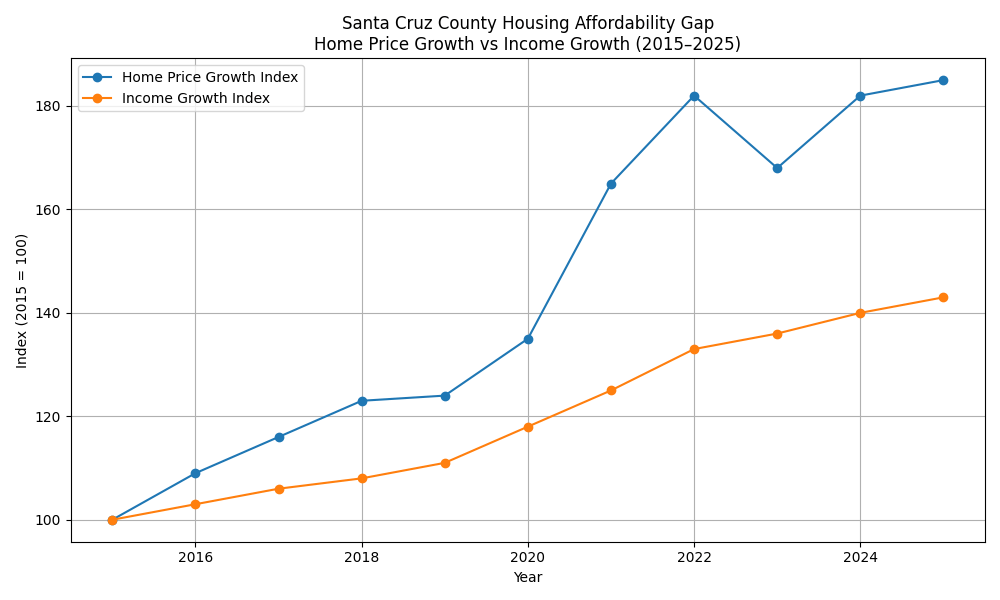
These figures show median home prices in Santa Cruz County roughly doubled over the last decade, with particularly steep increases around the pandemic years.
The Federal Housing Finance Agency’s house price index — a consistent way to track long-term price movements — shows prices in Santa Cruz rising steadily from an index base (2000=100) to over 256 by 2024. (FRED)
This means houses cost about 2.5× what they did on average in 2000, far outpacing wage growth in the region.
Median household income (latest estimates): ~$101,068 (Santa Cruz County)
Compared to median home prices exceeding $1.3M, the price-to-income ratio in Santa Cruz is extreme — significantly higher than what’s considered a healthy market (~3 or less). Recent state affordability trackers show Santa Cruz is among the toughest markets for buyers in CA. (Legislative Analyst's Office)
According to regional housing affordability data, the income required to qualify for a typical Santa Cruz home can exceed $220,000–$377,000+ — far above local median incomes — meaning many buyers must stretch financially or delay homeownership. (California Association of Realtors)
While prices soared for years, there are signs of cooling in 2025:
Redfin data—median sale price down ~8–15% compared to last year. (Redfin)
Zillow Home Value Index shows slight declines or flattening. (Zillow)
Days on market increased, hinting at less frenzied demand. (FRED)
Still, these reductions come from extraordinarily high levels — not from an affordable baseline.
Even before mortgage payments or rents, the wage structure in Santa Cruz County lags relative to skyrocketing housing costs. A large share of renters already pays over 30% of income on housing, indicating cost burden. (Data for Action)
Santa Cruz has seen very minimal housing stock growth compared to underlying demand — adding to price pressure over years. (San Francisco Chronicle)
Incomes are strong relative to some regions but not strong enough to keep up with home price growth — especially for service workers, educators, and first-time buyers.
✔ Millennials & first-time buyers face intensifying barriers as prices remain well ahead of incomes.
✔ Long-term homeowners benefit from equity appreciation but face tax and reinvestment decisions.
✔ Investors find cashflow rents somewhat attractive, but affordability metrics indicate continued long-term housing stress.
✔ Policy efforts focus on expanding affordable housing supply, particularly workforce housing for teachers, healthcare workers, and service providers. (Santa Cruz County)
Santa Cruz County’s housing market has transitioned from expensive to extraordinarily unaffordable over the last decade, with prices rising much faster than incomes. Even with recent softening, the gap between what homes cost and what locals earn remains one of the most significant affordability challenges in California.
For buyers and sellers alike, understanding these historical trends provides crucial context for local pricing, negotiating strategies, and future projections — and highlights why affordable housing remains a priority for policymakers and communities alike.
Stay up to date on the latest real estate trends.

2025’s Hidden Gems: The Best Cities to Buy Rental Property

Selling on your own likely means you’ll net a lower profit than when you sell with the help of an agent.
If you’re thinking about moving, selling your house this fall might be the way to go.

Americans still feel good about selling a house. Here’s why.
Look in their fridge for local brews, like New Bohemian, Rustic Ales, and Fruition Brewing.

Providing some charming festivities that you and your family can enjoy!

Common household products that we don’t think twice about can wreak havoc on your septic system.

Try these four easy home maintenance tasks that will help keep our eye on the prize.
I get it. Some days all I want to do is sit by the fire and watch movies with homemade popcorn.
Trusted for over 20 years, our team has decades of experience in fluctuating real estate markets and will arm you with knowledge so you can make the best decisions for you and your family. Let us help you to GRO your wealth through real estate!